
引用
方法引用
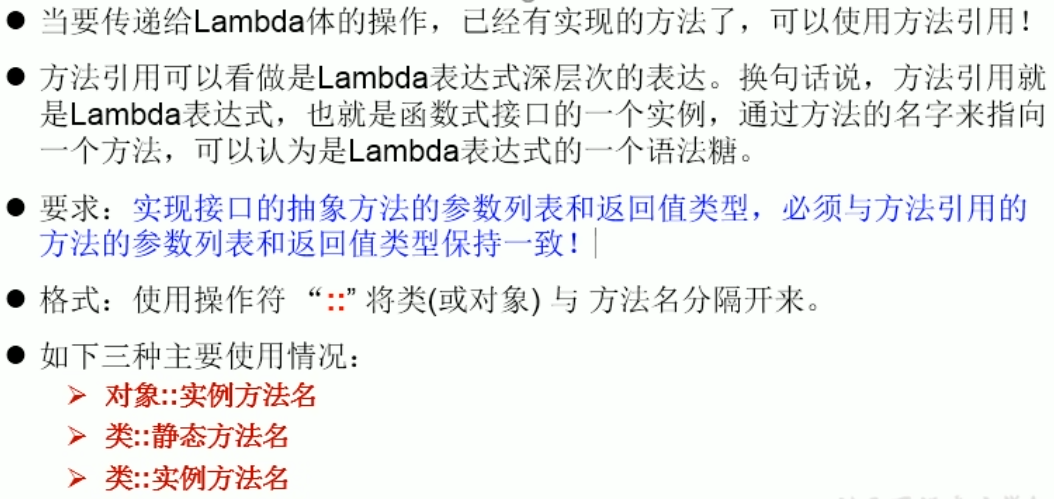
对象 :: 非静态方法
java
// Consumer中的void accept(T t)
// PrintStream中的void println(T t)

@Test
public void test1() {

    // lambda 表达式
    Consumer<String> con1 = str -> System.out.println(str);
    con1.accept("北京");

    // 方法引用
    PrintStream ps = System.out;
    Consumer<String> con2 = ps::println;
    con2.accept("beijing");
}类 :: 静态方法
java
// 情况三:类::静态方法
// Comparator中的int compare(T t1, T t2)
// Integer中的int compare(T t1, T t2)

@Test
public void test3() {

    // lambda 表达式
    Comparator<Integer> com1 = (t1, t2) -> Integer.compare(t1, t2);
    System.out.println(com1.compare(12, 21));

    // 方法引用
    Comparator<Integer> com2 = Integer::compare;
    System.out.println(com2.compare(12, 3));
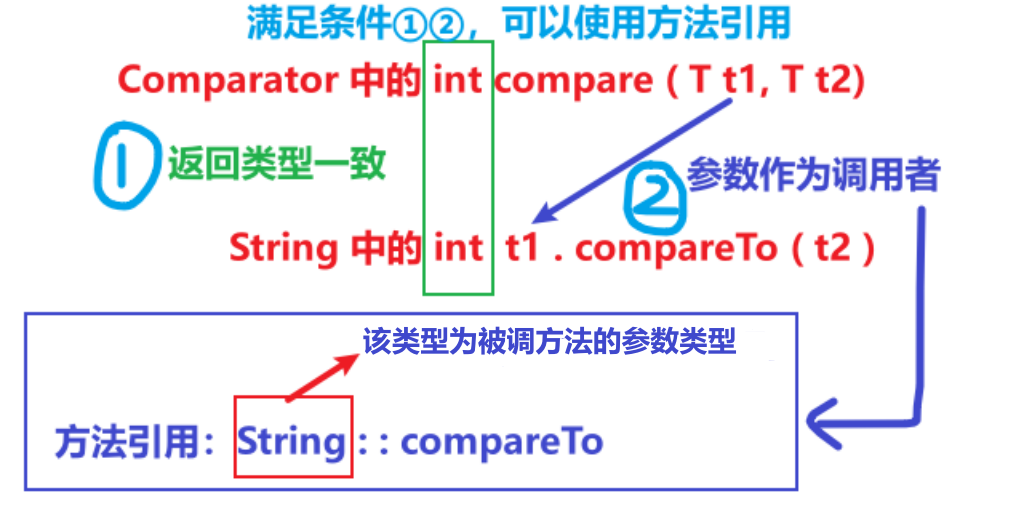
}类 :: 非静态方法
案例一(有第二个参数)
java
// 情况三:类::实例方法(有难度)
// Comparator中的int compare(T t1, T t2)
// String中的int t1.compareTo(t2)

@Test
public void test5() {

    // lambda 表达式
    Comparator<String> com1 = (s1, s2) -> s1.compareTo(s2);
    System.out.println(com1.compare("abc", "abd"));

     // 方法引用
    Comparator<String> com2 = String::compareTo;
}案例二(没有第二个参数)
java
// Function中的R apply(T t);
// Employee中的String getName();

@Test
public void test7() {

    Employee employee = new Employee(id: 1001, name: "Jerry", age: 23, salary: 6000);

    // lambda 表达式
    Function<Employee, String> func1 = e -> e.getName();
    System.out.println(func1.apply(employee));

     // 方法引用
    Function<Employee, String> func2 = Employee::getName;
}总结
如果调用的方法对象的类型和接口中需要实现的抽象方法中第一个参数的类型一致(第二个参数可有可无),则被调用的方法可以写成:对应类型的类名::调用方法名
构造器引用
案例一
java
// 构造器引用
// Supplier中的T get()
// Employee的空参构造器:Employee()

@Test
public void test1() {
    Supplier<Employee> sup = new Supplier<Employee>() {
        @Override
        public Employee get() {
            return new Employee();
        }
    };
    System.out.println("***********************");

    Supplier<Employee> sup1 = () -> new Employee();
    System.out.println(sup1.get());

    System.out.println("***********************");

    Supplier<Employee> sup2 = Employee::new;
    System.out.println(sup2.get());
}案例二
java
// Function中的R apply(T t)

@Test
public void test2() {
    Function<Integer, Employee> func1 = id -> new Employee(id);
    Employee employee = func1.apply(1001);
    System.out.println(employee);

    System.out.println("***********************");

    Function<Integer, Employee> func2 = Employee::new;
    Employee employee1 = func2.apply(1002);
    System.out.println(employee1);
}案例三
java
// BiFunction中的R apply(T t, U u)

@Test
public void test3() {
    BiFunction<Integer, String, Employee> func1 = (id, name) -> new Employee(id, name);
    System.out.println(func1.apply(1001, "Tom"));

    System.out.println("***********************");

    BiFunction<Integer, String, Employee> func2 = Employee::new;
    System.out.println(func2.apply(1001, "Tom"));
}总结
使用条件
函数式接口的抽象方法的形参列表和构造器的形参列表一致
写法:返回类型(类名) :: new
(1)抽象方法的返回类型即为构造器所属的类的类型
(2)调用哪个构造器会根据泛型(构造器参数类型...,返回类型)来确定,前提是该接口的抽象方法形参列表和构造器一致
数组引用
可以把数组看成是一个特殊的类,写法和构造器引用一致,返回的是数组而已
java
// 数组引用
// Function中的R apply(T t)

@Test
public void test4() {
    Function<Integer, String[]> func1 = length -> new String[length];
    String[] arr1 = func1.apply(5);
    System.out.println(Arrays.toString(arr1));

    System.out.println("***********************");

    Function<Integer, String[]> func2 = String[]::new;
    String[] arr2 = func2.apply(10);
    System.out.println(Arrays.toString(arr2));
}